The New York Times has an important article today that is must reading for all parents concerned about their young children's behavioral problems.
Bad Behavior Does Not Doom Pupils, Studies Say --by Benedict Carey
"Educators and psychologists have long feared that children entering school with behavior problems were doomed to fall behind in the upper grades. But two new studies suggest that those fears are exaggerated.
One concluded that kindergartners who are identified as troubled do as well academically as their peers in elementary school. The other found that children with attention deficit disorders suffer primarily from a delay in brain development, not from a deficit or flaw.
Experts say the findings of the two studies, being published today in separate journals, could change the way scientists, teachers and parents understand and manage children who are disruptive or emotionally withdrawn in the early years of school. The studies might even prompt a reassessment of the possible causes of disruptive behavior in some children.
“I think these may become landmark findings, forcing us to ask whether these acting-out kinds of problems are secondary to the inappropriate maturity expectations that some educators place on young children as soon as they enter classrooms,” said Sharon Landesman Ramey, director of the Georgetown University Center on Health and Education, who was not connected with either study. "
My comments: Parts of the article annoyed me. The experts seemed perfectly comfortable with kids' taking stimulants for ADHD until their development catches up with prevailing educational norms. They do concede that most kids grow out of ADHD. Why is American society so comfortable with drugging kids rather than changing schools so they can accommodate kids with different learning styles and different rates of cognitive development?
My two older children went to an excellent public school near the World Trade Center, run by a very gifted principal, Blossom Gelertner. Blossom felt that teachers and parents should not be concerned about boys who were slow to read until the boys were 8. My daughter teaches first grade in Boston; teachers now worry about kids who can't read when they enter first grade. I have always been an excellent reader, but I only learned my letters in first grade. By the end of the year, I was reading at a sixth grade level. Experienced parents have learned that readiness is all when it comes to crawling, walking, talking, toilet training, weaning, the move to a regular bed, etc. What have so many educators forgotten that lesson?
November 13, 2007


November 12, 2007
Duck and Cover, Assassinations, Civil Rights, and Vietnam
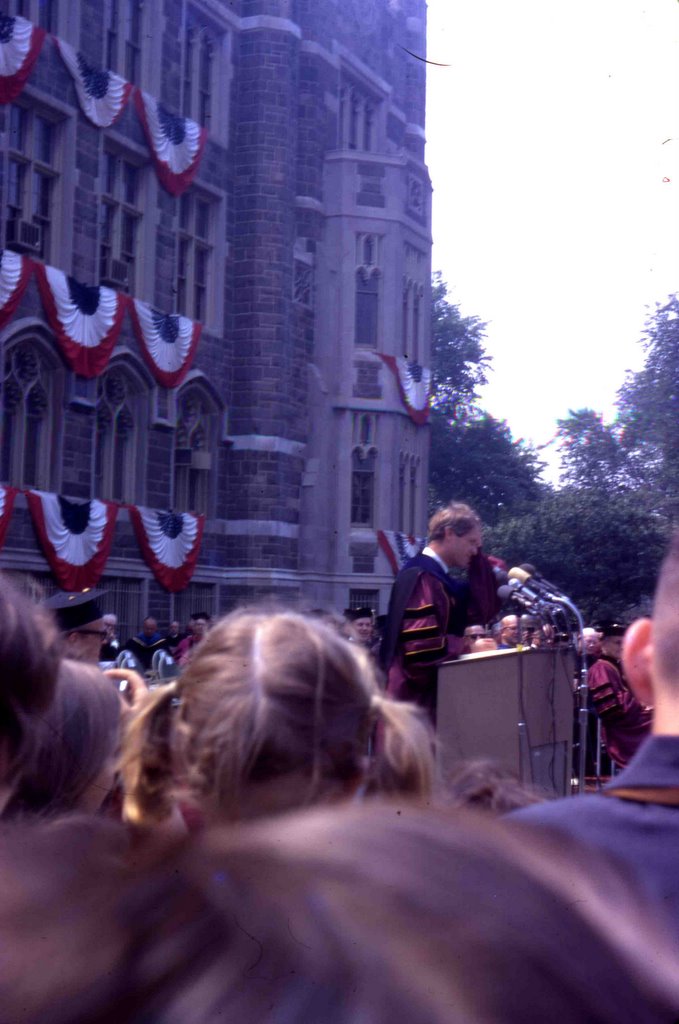 This is a picture of Robert Kennedy speaking at my graduation from Fordham University in 1967. RFK was running for president in 1968 when he was assassinated June 5, ten days before my wedding. I had a final wedding dress fitting the day of the assassination, and I was in tears the whole time.
My first specific political memory centered around the duck-and -cover, hide-under-our-desks, exercises that were a regular feature of my early school life from age 5 on. I knew enough about nuclear war to be terrified. We lived one mile away from an air force base, and I used to go out to the backyard, look up at the planes, and try to determine if they were American or Russian. I remember getting a book out of the library on aircraft identification. When I heard Joseph Stalin died, I remember asking if that meant no one would drop atom bombs on us.
In 1954 I had a severe case of the measles and Grandma Nolan came to help nurse me. She was listening to the Joseph McCarthy army hearings. Hatred of McCarthy's voice might have shaped my entire political development. In 1956, just turning eleven, I fell madly in love with Jack Kennedy as he made an unsuccessful bid for the vice presidential nomination. A good catholic school girl, I was initially attracted by his Catholicism; ten minutes later I was smitten by his intelligence, wit, and charm. I was luckier than his other women. Loving Jack Kennedy was good for me. I read about politics and history. From 1956 to 1963, I read everything I could about Kennedy, politics, American History.. When I was 15 I did volunteer work for his presidential campaign.
In high school we had political debates to imitate the famous Kennedy/Nixon debates and I represented Kennedy. What he believed in, I believed in. Gradually I moved to the left of his pragmatic liberalism. Certainly Kennedy was responsible for my decision to major in political science in college. Kennedy's assassination, occurring in the fall of my freshman year in college, devastated me. I felt like there had been a death in my immediate family. I quickly transferred my political allegiance to Bobby Kennedy.
I cannot precisely date my interest in and commitment to civil rights. When I was a freshman, I joined my college's Interracial Understanding Group. I was envious of those college students who could afford to spend the summer down south registering voters and didn't have to worry about money to pay their tuition.
Gradually during college I became a pacifist. Opposition to the Vietnam War right from the beginning was the catalyst. My husband to be, John, applied for conscientious objector status and was willing to face jail rather than be inducted. We became very active in the Catholic Peace Fellowship, the Fellowship of Reconciliation, and the War Resister's League, all pacifist organizations. We went on several anti-war demonstrations both in New York and Washington. I briefly attended Stanford University where resistance to the war was at its height. Almost every afternoon, David Harris, Joan Baez's future husband, spoke out eloquently against the war.
My first job after Stanford was as an assistant to Victor Riesel, a labor columnist, who had been blinded by acid thrown in his face by the mob who controlled the waterfront he was exposing. My assignments included reading the AP ticker to him every day, clipping and reading articles in about 20 newspaper and labor papers. This was in 1968, when King and Kennedy were assassinated, when anti-war protect was at its height, so thinking about politics were my job. My decision to go to law school, where I lasted two weeks, was motivated by my political convictions.
Mary Virginia Nolan was born August 11, 1921 in Brooklyn, NY. She is the second oldest of 8 children; she has five brothers and two sisters. One sister, Veronica, died at 2 years old. She grew up in Queens Village, NY. Her dad, a lawyer, died when she was 17 after being seriously ill most of her teenage years. Mary was always the super-responsible oldest daughter, trying to help her mom anyway she could. She attended Our Lady of Wisdom Academy in Ozone Park. She has kept up with her high school friends all her life. She was an excellent student and planned to attend college; she wanted to be a journalist. Her father's death changed everything, and she instead went to secretarial school and worked as a secretary. In her early 20's she attended Queens College at night, but stopped taking classes after she contacted pneumonia.
My Dad's Yearbook Profile
 No problem, riddle, or formula seems to be beyond his ken. He is the outstanding scientist of St. Francis College; he is the winner of the coveted Smith Memorial Medal for excellence in Science. Yet even his own brilliance could not fathom the enigma of Joe Koch. In many ways Joe is a walking paradox. He seldom laughs outright; in fact his picture would lead one to believe that he is a sombre pessimist. Yet it is his nimble wit that makes him a distinctive personality. His humor is never loud; rather it is whimsical and epigrammatic.
To be the leading scholar of the college it is necessary to do more work than the average. A student who is desirous of attaining official recognition must sit at home and do extra assignments. That is the normal procedure. But is that the form fol owed by our human riddle? Certainly not! He is actually scrupulous about not doing more than the assignment requires. He does exactly what he is demanded to do and not one jot more. What he does, however, is of such undeniable excellence that he was one of the first men picked for the Duns Scotus Honor Society.
With regards to one trait, however, Joe appears to contain no contradictions. That is his quality of intense loyalty to his friends.
Joe's Yearbook Profile
No problem, riddle, or formula seems to be beyond his ken. He is the outstanding scientist of St. Francis College; he is the winner of the coveted Smith Memorial Medal for excellence in Science. Yet even his own brilliance could not fathom the enigma of Joe Koch. In many ways Joe is a walking paradox. He seldom laughs outright; in fact his picture would lead one to believe that he is a sombre pessimist. Yet it is his nimble wit that makes him a distinctive personality. His humor is never loud; rather it is whimsical and epigrammatic.To be the leading scholar of the college it is necessary to do more work than the average. A student who is desirous of attaining official recognition must sit at home and do extra assignments. That is the normal procedure. But is that the form fol owed by our human riddle? Certainly not! He is actually scrupulous about not doing more than the assignment requires. He does exactly what he is demanded to do and not one jot more. What he does, however, is of such undeniable excellence that he was one of the first men picked for the Duns Scotus Honor Society.
With regards to one trait, however, Joe appears to contain no contradictions. That is his quality of intense loyalty to his friends.
Subscribe to:
Posts (Atom)