November 12, 2007

Little Brother

I have always loved this picture of me and my brother Joe, 18 months younger, taken in the fall of 1948. This might have been the last time I had the advantage over Joe. I seem smugly satisfied by his captivity. In my baby book my mom claims that "Mary Jo and Joe were always ahead of mother. Often though she forgot he was so small and played rough." I am dubious; he does not look intimidated. Joe always pulled the wool over mom's eyes. She never knew that Joe's babysitting consisted of taking his brothers out on the roof and daring them to jump into the swimming pool.

All our lives, I have never been sure when Joe is pulling my leg. For 50 years he made me feel guilty for pushing him down the cellar stairs in his walker. He blames all his academic inadequacies on the resulting head injury. I believed him since Andrew (3 years younger) and I were so much better students. Before her death my mom revealed that Lorraine, our next door neighbor, was the real culprit. Significantly, I thought I might have wanted to eliminate him.
From age 7, I regularly asked forgiveness in confession for hitting my brothers. The priest should have been more skeptical about my resolution of never doing it again.
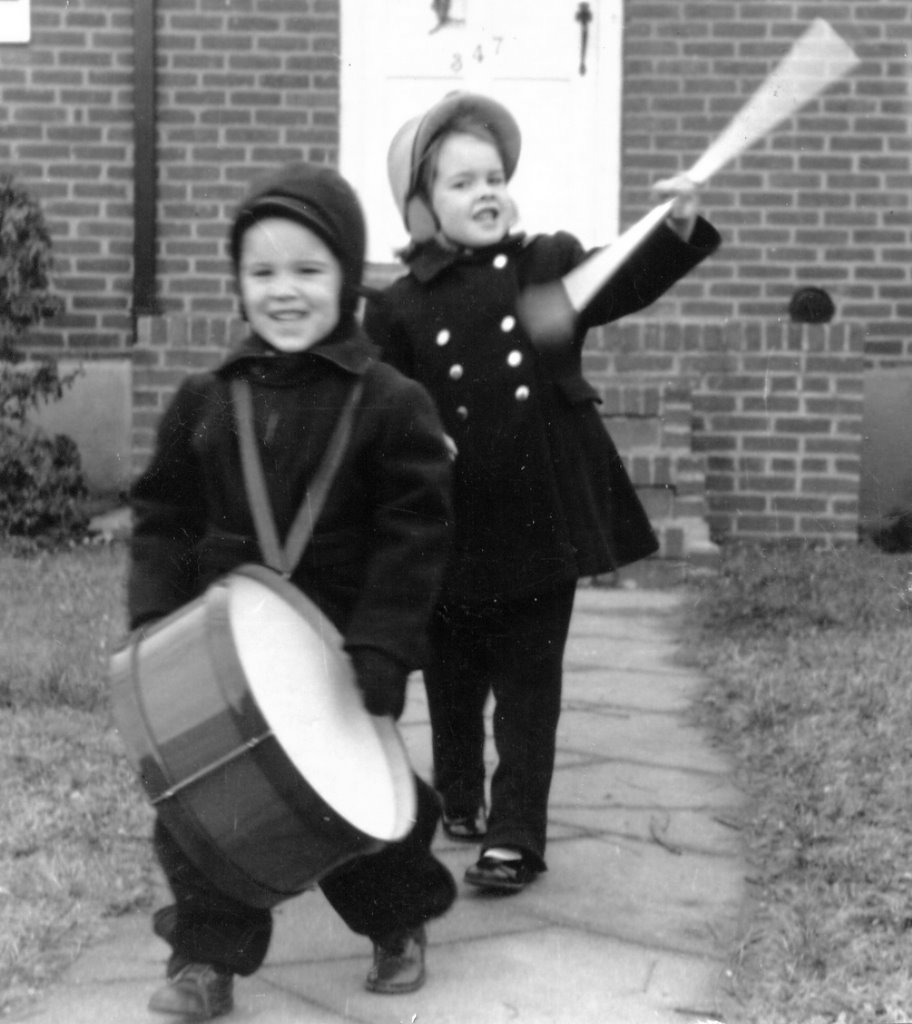
My mom and dad must have been dedicated to nurturing their children's unique gifts at whatever cost, so Santa was allowed to bring Joe a drum and me a baton. We lived in a tiny two bedroom, one bathroom, one-story house. Was Joe allowed to play the drum inside? This picture proves the falsity of Joe's accusation that I regularly beat him up. If I been a brother slayer, surely my mom and dad would not have trusted me with such an effective weapon. Richard obviously had not a fear in the world that my baton would come in contact with his head or his drum.

Joe is an amazing brother. I have always been in awe of him. Like my mom he much so much braver, bolder, eager to try new things, capable of stunningly creative mischief. I admired his becoming an altar boy when I knew Latin so much better. I admired his serving God and making a profit with wedding and funeral tips. I admired his persistence in track and cross country in high school when he never won and no one came to his meets. I admired his taking the driving test five separate times.

Joe came home from college with a trunk full of new shirts. He had been too busy gambling away his scholarship to do the laundry. Joe decided to try skiing for the first time the day before his wedding. He badly injured his knee and needed a shot of cortisone to limp his way up to the altar. The Epistle described how "my love comes leaping to me like a gazelle." I admired his courageous decision to resist induction into the army and go to jail if he didn't get conscientious objector status during the Vietnam War. I was impressed by his success at keeping his plan to refuse induction in 6 weeks a secret from his bride's family at the wedding.

Joe has fathered 6 children, been a prison librarian, ran a gas station, taught in a ghetto school, built a playground, sold coffee and ice cream, ran a chain of newspapers, been CFO of the largest US used truck company, owned an oil company, sold escalator efficiency equipment, and finally found fulfillment as CFO of his older daughter's company. He has always been a rock, supporting me and my daughters in all our trials and craziness. Sometimes his support is endless, infuriating advice. But I always know he persists in being wrong because he truly loves me.

Does Fear of Automatic Flushing Toilets Qualify as a Psychiatric Diagnosis?

The New York Times today has an interesting story on young children's fear of automatic flushing toilets. I certainly understand their fears. My daughter Rose was terrified of baths until her dad taught her the word "vortex" to explain the water draining out of the tub.

Buried in the article in this absurd statement:

Jerilyn Ross, president of the Anxiety Disorders Association of America, said that a fear of automatic toilets did not, in itself, meet the criteria for a psychiatric diagnosis. “Anxiety in and of itself is normal and healthy,” she said, “but when anxiety is excessive, irrational, and if it interferes with one’s daily life, then it may be an anxiety disorder, which is something that may need to be treated.”

Surely, some psychiatrists must question the tendency to make more and more human eccentricities and idiosyncracies grounds for psychiatric diagnosis.

November 11, 2007

Wartime Love Letters


Mary and Joe, March 6, 1944; honeymoon

For Remembrance Day, Mad Hatter published a fascinating post about boxes of wartime letters she found when remodeling her old house. Her post has special resonance for me because I have 20 plastic boxes full of letters my parents wrote from November 1942, when my dad was drafted, until February 1946, when he came home from France and saw me for the first time. I keep postponing doing something with themt. I started a blog of the letters, Mary and Joe: World War II Love Story, but I haven't kept it up. My father particularly was a wonderful writer, who never wrote anything but these letters. Mad Hatter inspired me to go back to that project.

My daughter Rose wrote this about the wartime letters several years ago. She included excerpts from the letters that I am not including here.
In my grandmother's house, past a stone Mexican statue named Harry, up the front stairs and to the right there is a bedroom. In this bedroom there are a pea green carpet, a bed with yellow and orange flowered sheets, and a cracked blue dresser. This dresser, unlike every other bureau and closet in this house, does not contain any seventies-style ties, old scarves, or early feminist t-shirts. Instead every drawer is filled with letters.

Joe lived in Jamaica, Queens, with his parents and six younger sisters and brothers. His college yearbook said of him, "Even his own brilliance could not fathom the enigma that is Joe." Mary lived in Queens Village. She was the second child, and the oldest girl, in a family of seven. Her high school yearbook described her as, "Sincerity coupled with bubbling vivacity, scholastic excellence with literary talents, athletic prowess, sparkling wit." She would not have a college yearbook until many years later, because her father had died without much life insurance when she was seventeen years old. Her father's brother squeezed together the money for her older brother to continue school at St. John's, but Mary was just a girl.

Mary and Joe had met the summer of 1942, on a raft at Loon Lake in the Adirondacks. He was 28, she was 21. A week later, back in Queens, he took her to see Bambi. They saw each other often in the three months after Bambi became Prince of the forest, and before Joe was drafted. He kissed her for the first time on the day he left for the army.

They will get engaged the night before her 22nd birthday in August 1943 and will marry the next March. The wedding will not be fancy, since it was planned in about four days and no one had much money anyway. The reception will be in Mary's backyard. Joe will go off to war in Europe, though his bad vision will ensure that he never faces combat. They will have their first child while he is away. There will be short letters to Baby Mary Jo, my mother, enclosed with the longer ones to Mary. Then in 1946, when Mary Jo is eight months old, Joe will finally come home and the letters will end.

They will have five more children, and the children will have fourteen kids of their own. Joe will die of Alzheimer's disease in May of 1987. Mary will become a lobbyist and counselor for victims of the disease and their families. She will become even more involved with her church, and even more of a rock for her distressingly heathen children and grandchildren. Mary will die in April 2004 of Progressive Supranuclear Palsy.

My grandparents' generation has been called "The Greatest Generation." They survived the depression, they fought Hitler. Yes, they did, but many of them also contributed to horrible racial injustice, and a few of them dropped the bomb. I suppose that talking about our parents' and grandparents' moral superiority is an improvement over not trusting them because they're over forty, but it's not much of an improvement. It would be far more honest to say that they did some very good things, and some very bad things. They had fewer toys, and certainly they wrote better love letters, but they were more or less just like us.

To put it another way, generation schmeneration. I'm not going to even try to judge. Instead I will sit here and read these letters. I will learn that my mother's mother is more than the grandma who babysat for us almost every week for ten years, and who is always inappropriately freezing things. I will learn that my mother's father was far more than the sick, confused old man I remember.

What We Wanted for Christmas

How did we know what we wanted for Christmas in the days before television, glossy newspaper and magazine advertisements? The Sears Christmas Wish Book was our bible. After it came in early November, my mom used to hide it for a few weeks, so we didn't have months to want things she couldn't afford to give us. I don't recall regular visits to department stores, though we probably did visit Santa Claus occasionally.

We had more generic requests--bikes, trains, truck, dolls, chemistry sets, tinker toys--than kids do today. I recall being thrilled with a cake baking set. We didn't long for specific brands, colors, sizes. Our presents did not require batteries. We were aware that mom and dad were not rich.

But my memory could be playing tricks on me. Perhaps I spent hours gazing over the Sears catalog and coming up with a 25-item list. In my old age, I have learned to mistrust memories that compare me favorably to younger generations. When my daughter Rose was 5, she said, "anything Santa wants to bring me for Christmas is fine with me." I doubt my brothers and I would have been so unmaterialistic.

November 9, 2007

Lady in Red


1947, 1948, 1957, 1971
Both Andrea and Bub and Pie have excellent posts about color. As the above pictures show, red has always been my favorite color since I was a little girl. My first tricycle was red. My blogs have a red banner, and the sidebar text is red. I have always wanted a red living room, but only managed to have one after my first marriage ended and my three older girls had left home. My red living room makes me happy as does my yellow kitchen, my blue bathroom, and my green bedroom. I struggle with depression, and red is the only reliable anti-depressant for me. "Better red than dead" has more than a political meaning.

When I met my first and second husbands I was wearing a red dress. I wore red for my second marriage. I love wearing red hats. I love red shoes, but find them hard to find for my wide feet. My favorite shoes ever were a pair of red suede boots. It is very easy to go shopping if you are looking for red, either in a thrift shop or a department store.

At job interviews with a man, I have worn red; with a woman, anything but red. Once, when I was manic, I had a red sweat shirt made up that proclaimed, "Never love a man who doesn't love Jane Austen, Doris Lessing, and Margaret Drabble." The owner of the shop told me no shirt had evoked more comment. Her favorite was a man who reacted, "That poor woman; she lives in the wrong country." Obviously he was right since I married an Englishman.

My favorite coat is a bright red fleece jacket I inherited from my mom when she died 3 years ago. When I wear it, I sometimes feel like she is giving me a hug. When I meet someone in Manhattan, I am easy to find--straight silver hair wearing red. It's sad how few New Yorkers wear red. PerhapstNew Yorkers should commemorate 9/11 by wearing red.

Reading Bub's Post, I wondered how I reconcile my lifelong introversion with red. Red is how I cope with my shyness. If I wasn't wearing red to a party or a meeting, I might disappear. When I am manic, I cope best by going to NYC , wearing red, and talking to strangers.Now at 62, I suspect my silver hair absolutely cancels out my redness.