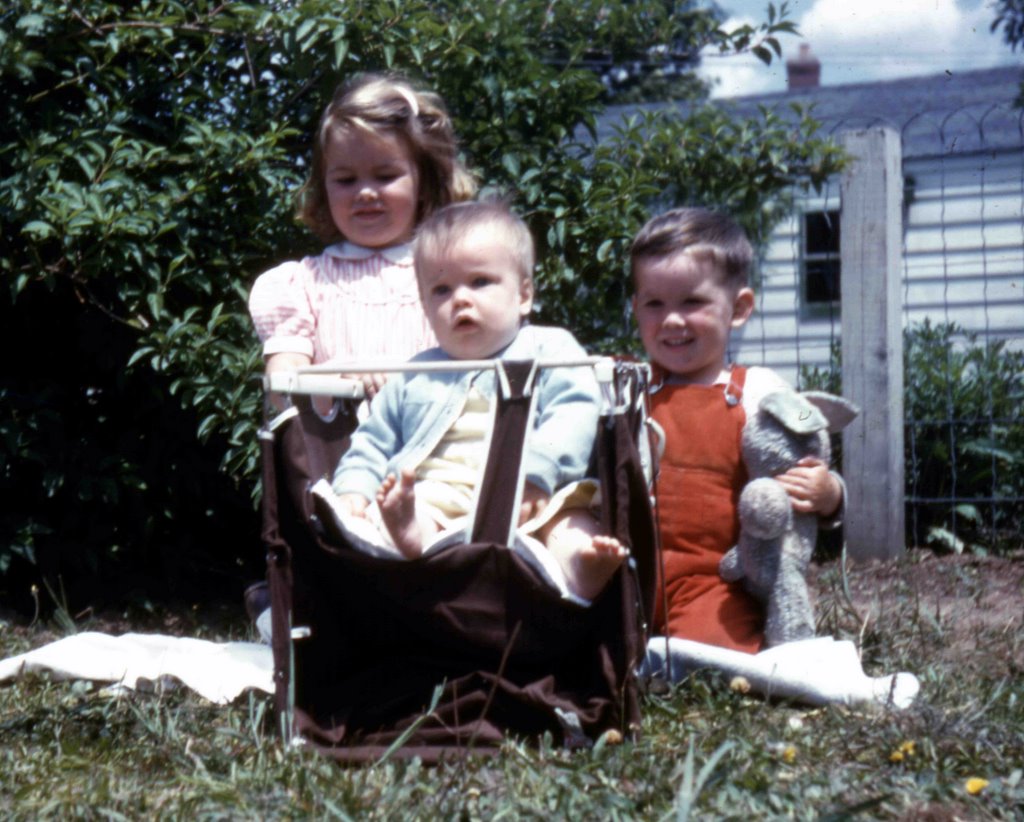
 This was taken in the summer of 1949. I am just turning four; Richard is two and one half; Stephen is about 7 months. I do have some vague memories of Stephen as a baby, but they are not specific. Stephen and I were blondes to begin with; my hair is already turning dark. Richard always had dark hair; I think he has changed the least over the years.
January 13, 2006
Mary Jo, Richard, Stephen, 1949
This was taken in the summer of 1949. I am just turning four; Richard is two and one half; Stephen is about 7 months. I do have some vague memories of Stephen as a baby, but they are not specific. Stephen and I were blondes to begin with; my hair is already turning dark. Richard always had dark hair; I think he has changed the least over the years.


Joe Meets Mary
Her name was Mary, of course. She was a blue-eyed, smiling, long-legged, cool looking girl--a trifle naive. A girl with class he thought when he first saw her,but young. A bus seems an awful place for things to start, but there was she on a bus going to church and planning to have a chocolate ice cream cone with sprinkelettes. He was going to church too, but she sat in back of him and that was that.
He said hello to her that afternoon or more likely she said hello to him. Again nothing happened--there are lots of shapely girls in blue bathing suits at a lake summer resort. The summer resort was one of those let’s-be-one’big-happy-family sort of places--it even had a social director and a social directrix. Naturally one afternoon there was a baseball game in which all the boys and girls (in those places they’re all boys and girls even if the boys and girls have big boys and girls of their own) were to participate. Well this particular boy and girl were antisocial or mutually social. They sat out the ball game on a raft. Long afterward he learned her reason why she was there but being a romantic still doesn’t believe it.
They talked about prosaic things--families and schools; after all he was a shy young man. She wasn’t. Maybe that is why he was sure it happened then. That’s the trouble with shy young men: they are not used to openhearted friendliness. He never knew what she saw in him, but for the rest of the week they were summer friends. He struggled a little bit--an inherent male instinct. Why one rainy afternoon they went to a Bing Crosby movie in separate groups. They had only a week, not even a full one.
However, this time it did happen on a bus. They had made some sort of plan to ride back to New York on the same bus. He from the summer resort, she from Albany where she was visiting. He was positive. She says it couldn’t haven happened then--that soon.
He didn’t know the proper method of courting a girl, not a beautiful one like her. Oh he was quite proper. The movies he took her to were always approved for adults and children. A baseball game, a few football games, a little bowling--that was about all. He didn’t have much time, altogether three months. He then went away as did twelve million other men young and old. Oh yes, he finally kissed her once. He was very proper and very shy and afraid she would say no.
He said hello to her that afternoon or more likely she said hello to him. Again nothing happened--there are lots of shapely girls in blue bathing suits at a lake summer resort. The summer resort was one of those let’s-be-one’big-happy-family sort of places--it even had a social director and a social directrix. Naturally one afternoon there was a baseball game in which all the boys and girls (in those places they’re all boys and girls even if the boys and girls have big boys and girls of their own) were to participate. Well this particular boy and girl were antisocial or mutually social. They sat out the ball game on a raft. Long afterward he learned her reason why she was there but being a romantic still doesn’t believe it.
They talked about prosaic things--families and schools; after all he was a shy young man. She wasn’t. Maybe that is why he was sure it happened then. That’s the trouble with shy young men: they are not used to openhearted friendliness. He never knew what she saw in him, but for the rest of the week they were summer friends. He struggled a little bit--an inherent male instinct. Why one rainy afternoon they went to a Bing Crosby movie in separate groups. They had only a week, not even a full one.
However, this time it did happen on a bus. They had made some sort of plan to ride back to New York on the same bus. He from the summer resort, she from Albany where she was visiting. He was positive. She says it couldn’t haven happened then--that soon.
He didn’t know the proper method of courting a girl, not a beautiful one like her. Oh he was quite proper. The movies he took her to were always approved for adults and children. A baseball game, a few football games, a little bowling--that was about all. He didn’t have much time, altogether three months. He then went away as did twelve million other men young and old. Oh yes, he finally kissed her once. He was very proper and very shy and afraid she would say no.
January 12, 2006
In My Grandmother's House
My daughter Katherine wrote this about the wartime letters:
In my grandmother's house, past a stone Mexican statue named Harry, up the front stairs and to the right there is a bedroom. In this bedroom there are a pea green carpet, a bed with yellow and orange flowered sheets, and a cracked blue dresser. This dresser, unlike every other bureau and closet in this house, does not contain any seventies-style ties, old scarves, or early feminist t-shirts. Instead every drawer is filled with letters.
Joe lived in Jamaica, Queens, with his parents and six younger sisters and brothers. His college yearbook said of him, "Even his own brilliance could not fathom the enigma that is Joe." Mary lived in Queens Village. She was the second child, and the oldest girl, in a family of seven. Her high school yearbook described her as, "Sincerity coupled with bubbling vivacity, scholastic excellence with literary talents, athletic prowess, sparkling wit." She would not have a college yearbook until many years later, because her father had died without much life insurance when she was seventeen years old. Her father's brother squeezed together the money for her older brother to continue school at St. John's, but Mary was just a girl.
Mary and Joe had met the summer of 1942, on a raft at Loon Lake in the Adirondacks. He was 28, she was 21. A week later, back in Queens, he took her to see Bambi. They saw each other often in the three months after Bambi became Prince of the forest, and before Joe was drafted. He kissed her for the first time on the day he left for the army.
They will get engaged the night before her 22nd birthday in August 1943 and will marry the next March. The wedding will not be fancy, since it was planned in about four days and no one had much money anyway. The reception will be in Mary's backyard. Joe will go off to war in Europe, though his bad vision will ensure that he never faces combat. They will have their first child while he is away. There will be short letters to Baby Mary Jo, my mother, enclosed with the longer ones to Mary. Then in 1946, when Mary Jo is eight months old, Joe will finally come home and the letters will end.
They will have five more children, and the children will have fourteen kids of their own. Joe will die of Alzheimer's disease in May of 1987. Mary will become a lobbyist and counselor for victims of the disease and their families. She will become even more involved with her church,and even more of a rock for her distressingly heathen children and grandchildren. Mary will die in April 2004 of Progressive Supranuclear Palsy.
My grandparents' generation has been called "The Greatest Generation." They survived the depression, they fought Hitler. Yes, they did, but many of them also contributed to horrible racial inustice, and a few of them dropped the bomb. I suppose that talking about our parents' and grandparents' moral superiority is an improvement over not trusting them because they're over forty, but it's not much of an improvement. It would be far more honest to say that they did some very good things, and some very bad things. They had fewer toys, and certainly they wrote better love letters, but they were more or less just like us.
To put it another way, generation schmeneration. I'm not going to even try to judge. Instead I will sit here and read these letters. I will learn that my mother's mother is more than the grandma who babysat for us almost every week for ten years, and who is always inappropriately freezing things. I will learn that my mother's father was far more than the sick, confused old man I remember.
In my grandmother's house, past a stone Mexican statue named Harry, up the front stairs and to the right there is a bedroom. In this bedroom there are a pea green carpet, a bed with yellow and orange flowered sheets, and a cracked blue dresser. This dresser, unlike every other bureau and closet in this house, does not contain any seventies-style ties, old scarves, or early feminist t-shirts. Instead every drawer is filled with letters.
Joe lived in Jamaica, Queens, with his parents and six younger sisters and brothers. His college yearbook said of him, "Even his own brilliance could not fathom the enigma that is Joe." Mary lived in Queens Village. She was the second child, and the oldest girl, in a family of seven. Her high school yearbook described her as, "Sincerity coupled with bubbling vivacity, scholastic excellence with literary talents, athletic prowess, sparkling wit." She would not have a college yearbook until many years later, because her father had died without much life insurance when she was seventeen years old. Her father's brother squeezed together the money for her older brother to continue school at St. John's, but Mary was just a girl.
Mary and Joe had met the summer of 1942, on a raft at Loon Lake in the Adirondacks. He was 28, she was 21. A week later, back in Queens, he took her to see Bambi. They saw each other often in the three months after Bambi became Prince of the forest, and before Joe was drafted. He kissed her for the first time on the day he left for the army.
They will get engaged the night before her 22nd birthday in August 1943 and will marry the next March. The wedding will not be fancy, since it was planned in about four days and no one had much money anyway. The reception will be in Mary's backyard. Joe will go off to war in Europe, though his bad vision will ensure that he never faces combat. They will have their first child while he is away. There will be short letters to Baby Mary Jo, my mother, enclosed with the longer ones to Mary. Then in 1946, when Mary Jo is eight months old, Joe will finally come home and the letters will end.
They will have five more children, and the children will have fourteen kids of their own. Joe will die of Alzheimer's disease in May of 1987. Mary will become a lobbyist and counselor for victims of the disease and their families. She will become even more involved with her church,and even more of a rock for her distressingly heathen children and grandchildren. Mary will die in April 2004 of Progressive Supranuclear Palsy.
My grandparents' generation has been called "The Greatest Generation." They survived the depression, they fought Hitler. Yes, they did, but many of them also contributed to horrible racial inustice, and a few of them dropped the bomb. I suppose that talking about our parents' and grandparents' moral superiority is an improvement over not trusting them because they're over forty, but it's not much of an improvement. It would be far more honest to say that they did some very good things, and some very bad things. They had fewer toys, and certainly they wrote better love letters, but they were more or less just like us.
To put it another way, generation schmeneration. I'm not going to even try to judge. Instead I will sit here and read these letters. I will learn that my mother's mother is more than the grandma who babysat for us almost every week for ten years, and who is always inappropriately freezing things. I will learn that my mother's father was far more than the sick, confused old man I remember.
January 11, 2006
Who Am I
I am the oldest daughter of Mary and Joe; that's why they named me Mary Jo. I was born at the end of World War II, July 17, 1945. My father was in France and did not see me until the following February.
I have always been fascinated by my parents' wartime love letters. I have many boxes of them, all in their original envelopes, all in careful chronological order. Now that they are both dead, I want to bring them to life again in this blog.
I have always been fascinated by my parents' wartime love letters. I have many boxes of them, all in their original envelopes, all in careful chronological order. Now that they are both dead, I want to bring them to life again in this blog.
Subscribe to:
Posts (Atom)