Dear Mary Jo,
While I wasn't sure where I stood in the family's IQ department, I knew who number one was. I guess I've told the story a hundred times. When my big sister went to Our Lady of Wisdom Academy, in her first semester, she had the highest grades in the school. She was pretty, had many friends, ever so popular and very smart. Her kid brother stood in awe.
How proud I was to be asked at 17 to act as her Daddy and "give her away." You've seen the pictures. All the young men were in uniforms and I was a 6" Captain in the ROTC, resplendent with a so-called Sam Brown belt.
The wedding, the ceremony itself and reception were put together in great haste since your dad was to be home for only a short time. All the neighbors and relatives were invited, and there was a great spread of home-cooked food at our home-105-11-220 St. Queens Village. The Mass was in the morning and then we walked home, about 1/3 mile. It was a chilly day and I think it was rainy. Your father was talkative! Your mother was radiant, her happiness not to be forgotten.
I didn't know your father very well. I knew the rumors. He too had a great brain. I believe the people who viewed the results of his IQ test upon his induction at Camp Dix were startled. I was not impressed however with the ability of either of your parents to select a vacation location.
I knew they met at Loon Lake but apparently had eyes only for each other. In 1949 Shirley and I took our first vacation and stayed where my big sister fell in love. Was it called the McAvay House? Perhaps it was McDump. No A/C in those days but also no screens and very hot and this tall boy kept hitting his head on the ceiling. We left early. You will remember we had some vacations together. Didn't we spent a week or so in East Marion, L.I.? These many years later our new home is quite near that area.
Your mother is an extraordinary woman; you can be proud to be her daughter as I am to be her brother.
Love, Bob
December 16, 2005


Army Life
 "I recall that on one Sunday afternoon, about five hundred years ago, someone told me how the army made a friend of theirs so much bolder. I hope you're not drawing a parallel. If you had higher mathematics at Queens college, you show know that, according to Riemannian geometry, there are no parallels. It's not the army, Mary; it's the fountain pen for a mighty man with pen and ink, am I. In all these years it's been a hidden talent.
Since one Nolan at least is interested in the army, I should begin by describing the process of Uptonizing. The prospective soldiers arrive in Camp Upton (I can't tell you how since that is a troop movement and troop movements are military secrets) late in the afternoon , and the balance of the day and night is spent in being acclimated. This involves standing out in the open, swept by cold winds (and rain if there is any) until the body temperature is about 40 degrees, and then marched into a building to thaw out. Just so this time is not wasted, they dish out either a meal or a test.
I was lucky because my first day ended at 11 pm; if my name began with a "z" it probably would have concluded at about 4 am. The next day the process is repeated beginning at 5 am--it is dark at this unearthly hour . However, after breakfast and after the inevitable standing around being counted and recounted , we were marched into the processing unit. I entered one door as a civilian and came out a fully uniformed soldier (in fact, carrying three other complete uniforms in a large canvas bag), possessing an insurance policy, and bearing the imprints of typhoid, anti-tetanus, and smallpox innoculations. After that the entire group is marched to the cinema to see a double feature entitled, "What Every Young Soldier Should Know." Thus ends the process and the solider is usually sent to some other camp for basic training.
But you are probably saying to yourself, Joe must be still at Camp Upton because the envelope says so. Yes I am still out here in the woods. It seems that I'm on a special detail; the requirements for which seem to (1) that you wear glasses, and (2) that you pass the intelligence test (I got 151 but I always knew I was a genius). After working for a week I don't think the second requirement is at all necessary. On the whole work is rather easy--just routine clerical work handling the records of the incoming soldiers ,but there is certainly enough of it.
Because of our work we live in a special row of tents. I'm sleeping in a 6 man tent and believe it or not, my principal complaint is that it is too hot. One of the soldiers in my tent was formerly a fireman on a Coast Guard rum chaser during prohibition days: he has appinted himself chief of the tent stove and he keeps it red hot night and day. Even on the windiest days the temperature inside our tent is about 85. We use coal so we're not affected by oil rationing. Heh, Heh."
Interview with Mom, 1980
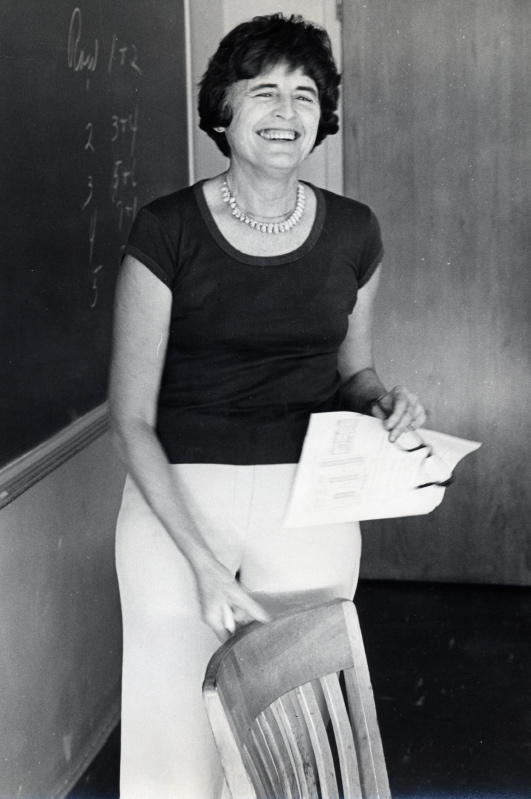 Interviewed by Cynthia Nieves
Mrs. Mary Koch is a social studies instructor who teaches at Uniondale High. This year will be her last at the high school as she moves on into another phase of her life, a phase she describes as one in which there is a
need for change, a different type of growth. I was fortunate enough to have the opportunity to interview her. I never was able to know her personally, but in the passage of a mere half hour I found her to be an incredibly refreshing individual--one with courage, enthusiasm, and an unquenchable desire constantly to expand her intellectual horizons.
Q. How many years have you taught and how many of those years were spent at Uniondale High?
A. I have taught eleven years and all have been spent at Uniondale High.
Q. What do you feel is the most rewarding experience you have gained during your teaching career?
A. I would have to say my association with the students. I decided to teach at the high school level because I felt the students, being older and more mature, would have more to say and offer on an intellectual level than at an elementary school.
Q. Why did you decided to become a history teacher and did not choose English or math, etc?
A. I've always enjoyed history. I majored in history and acquired my masters in it as well. I had originally planned to be a journalist, but changes in my life--marriage and other things--led me to teaching, and being interested in politics as well, I decided to teach a course I myself enjoy.
Q. Do you feel the students of today are much different from the students of yesterday?
A. When I first came, there was much more turbulence because of the times. I find that students are less involved in public affairs now. At that time, when I began to teach, there was more interest in government and the welfare of the world than there is now. Apathy is the big problem. I have seen positive changes in the young women especially. Girls are much more involved in sports and positions of leadership today.
Q. What do you plan to do after you retire?
A. I don't think of myself as "retiring." I feel this is an important phase in my life, and I want to change, to do something different. I plan to work for this organization called Bread for the World--a lobby-like group that hopes to influence Congress into aiding the hungry, starved,
underdeveloped nations in the world. Having a deep interest in politics, I believe this is a movement that I will help grow--so in reality, I'm not leaving education.
Q. If you had it all to do over again, would you teach?
A. Probably not. In terms of today's world and the new roles women have taken--the whole array of opportunities available--I would definitely go into law if I had it all to do over again. It's not that I regret teaching. It's just that it was the sensible thing to do in that period of my life. It ws good for me.
Q. How would you sum up your years at Uniondale?
A. Happy years overall. Of course there were times of discontent and discouragement when I couldn't seem to get pupils excited and interested in learning, but for that phase of my life it was good for me. Now it's ti me to move on. I'm excited about doing something new.
Q. Is there anything you'd care to say, before we close, to the students.
A. Yes. Be involved . Be committed. Students just sort of drift now. Live! One needs to care about people, the world. I only hope that I can educate the public about the people who need compassion, an outstretched hand. One always needs to keep trying.
Subscribe to:
Posts (Atom)